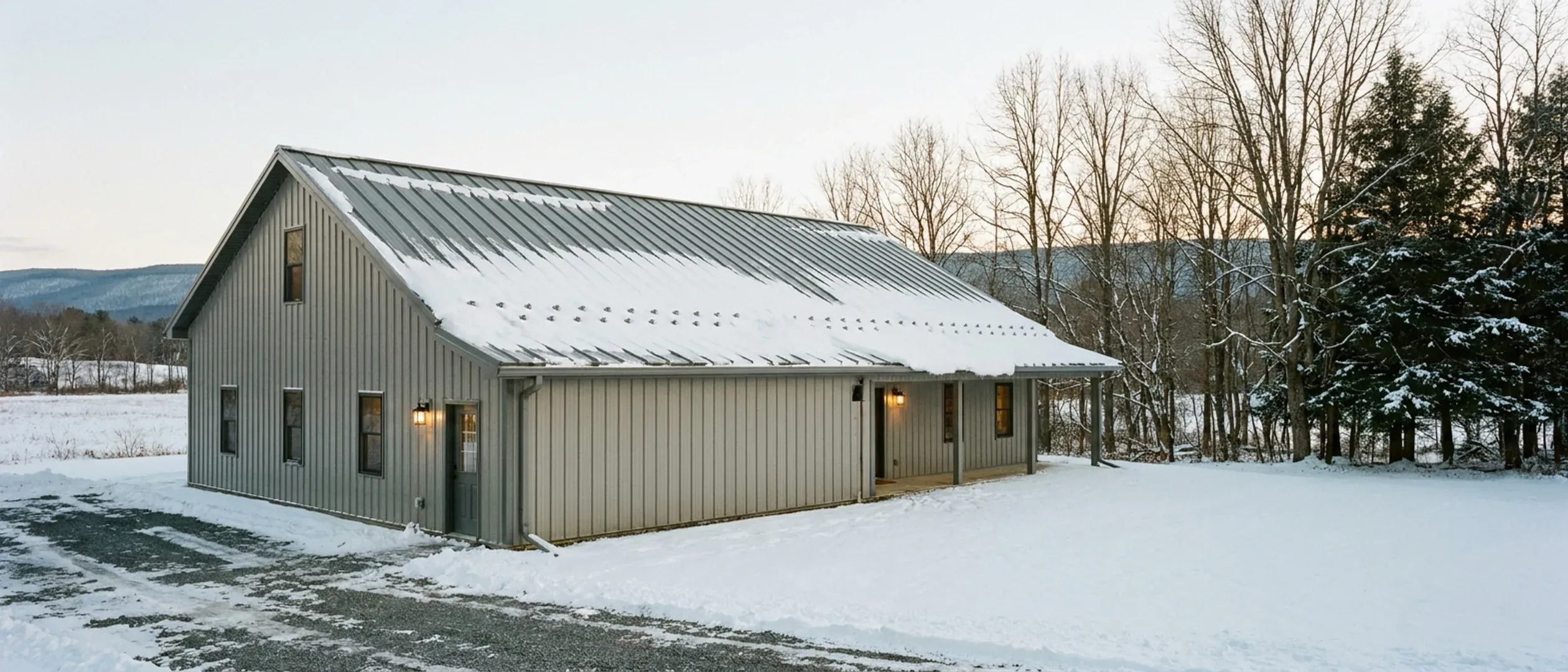
Are Barndominiums Worth It in Pennsylvania? Land, Appraisal, Insurance and Resale
Whether a barndominium is worth it depends less on the building than on what you need it to do and where it will stand. In Pennsylvania the answer usually turns on the land: whether the soil will take an on-lot sewage system, what the appraiser will compare the finished house to, and which risks a standard homeowners policy leaves out. This page sets out when a barndominium is clearly worth building, when it usually is not, and the checks to make before committing. It does not give our own prices. The cost guide cites third-party figures.
Figures on this page are cited third-party or government data, not a quote from Pennsylvania Barndominium Builders.
Bottom Line Up Front
- A barndominium is most clearly worth it when you need a large shop, equipment bay or garage anyway and want it under the same roof and on the same foundation as the house.
- It is least clearly worth it when you want a conventional house on a small lot, plan to sell within a few years, or will need a loan on land where there are few comparable sales.
- In Pennsylvania, settle four things before deciding: whether the land passes sewage soil testing, what a lender's appraiser will compare the house to, whether the site needs flood or mine subsidence cover, and who permits and inspects in that municipality.
When a barndominium is usually worth it
The case is strongest when the building's structural advantages match what you actually need.
You need the shop anyway
If the plan already includes a large shop, equipment bay or garage, putting it and the house on one foundation under one roof is the barndominium's clearest advantage.
You want an open plan that can change
With no interior bearing walls, the layout can be rearranged later without structural work.
You are staying a long time
The value of a building designed around how you live and work grows the longer you use it, and matters less when a buyer's view of it arrives decades later.
The land is already right
Sewage soil testing passed, water available, no flood or mine question left unanswered, and zoning that allows a dwelling. On land like that, the remaining questions are about the building.
When it usually is not
None of these rules a barndominium out. Each means the case needs a closer look.
You want a conventional house on a small lot
Without the shop or the space, most of the structural advantage is unused, and a municipality's zoning rules may shape what can be built on a small lot.
You may sell within a few years
An unusual building type can take longer to sell, and the pool of buyers looking for a house with a large shop is smaller than the pool looking for a conventional house.
The loan depends on a high appraisal
Where the appraiser has to reach for distant or older comparables, the valuation can come in below the cost of what was built, and the difference comes out of your cash.
The shop is bigger than the house needs
Fannie Mae says significant outbuildings such as large barns or storage areas may indicate that a property is agricultural in nature and that the lender must decide whether it is residential. A shop far larger than the house can raise the same question.
What to check before deciding
Each of these is quicker and cheaper to answer before the land is bought or the kit is ordered.
Sewage soil testing
Contact the local agency's Sewage Enforcement Officer for the municipality: it may be the municipality itself, a joint local agency or, in some counties, the county health department.
An insurance quote on the actual design
Replacement cost or actual cash value, the wind and hail deductibles, and whether the site needs flood or mine subsidence cover.
A lender that has financed one
Ask how its appraisers have valued barndominiums on rural land nearby. The financing guide covers the loan types.
Who permits and inspects on your land
The municipality, or the third-party agency it works with, or, where it has opted out of administering the code, a certified agency you hire. The legal guide explains the difference.
Clean and Green status
If the land is enrolled in Clean and Green, Pennsylvania's preferential assessment program, splitting off a house lot or changing the land's use can trigger roll-back taxes: up to seven years of tax savings plus 6 percent interest. Ask the county assessment office before you buy or subdivide.
Water, radon and flood maps
A well test once the well is drilled, a radon test once the house is occupied, and a look at the flood map before the building is placed on the site.
Reading this because you are weighing a build? The next step is a plan drawn for your program.
What's different about Pennsylvania
The land has to pass sewage testing first
Where there is no public sewer, the house needs an on-lot sewage permit from the local agency's Sewage Enforcement Officer, and the soil is tested before the permit is issued. Under 25 Pa. Code § 73.14, when the soil profile shows a limiting zone within 20 inches of the mineral soil surface, percolation tests may not be conducted and a permit will be denied, apart from narrow exceptions. A barndominium is only worth it on land where a house can be permitted at all, so make the testing a condition of buying rural land wherever the seller will agree to it.
Appraisal on rural land
Fannie Mae's Selling Guide says rural properties often have a shortage, or absence, of recent truly comparable sales nearby, and allows appraisers to use comparables a considerable distance away, or older sales where a rural area has minimal sales activity, provided they explain why. It also acknowledges that the nature of the improvements themselves can leave an appraiser without truly comparable sales. A barndominium on acreage can meet both conditions at once, which is why the appraisal, not the construction budget, is often what limits the loan.
Insure the finished building to replacement cost
The Pennsylvania Insurance Department's homeowners guide recommends carrying 100 percent replacement coverage and explains that most companies require a homeowner to insure at least 80 percent of the replacement cost, with a partial-loss penalty below that line. In March 2026 the department also urged homeowners to check whether they are insured for replacement cost or actual cash value and what their peril-specific wind and hail deductibles are. Get a quote on the actual design, with its metal roof and shop space, before you commit: an unusual building is exactly where those answers vary between insurers.
Flood and mine subsidence are separate policies
The Pennsylvania Insurance Department says loss due to flood is excluded from all homeowners policies and that National Flood Insurance Program cover usually has a 30-day waiting period. It also says sinkhole and earth-movement damage is generally excluded. DEP's Mine Subsidence Insurance programme covers damage from the collapse of underground coal and clay mines, including buildings under construction, and quotes $41.25 a year for $150,000 of residential coverage. Neither makes a barndominium a bad idea, but both belong in the running cost of the site you choose.
There is no agricultural shortcut
The Uniform Construction Code excludes agricultural buildings, but the statutory definition of an agricultural building excludes habitable space, and the code's recreational cabin exclusion applies only to a cabin that is not used as anyone's residence. A barndominium that someone lives in is built, permitted and inspected as a house. Any plan whose numbers depend on avoiding that is not a plan.
Water and radon are running costs, not surprises
Penn State Extension says private water supplies in Pennsylvania are not regulated and that testing, maintenance and treatment are the property owner's responsibility. The Department of Environmental Protection says approximately 40 percent of homes tested in Pennsylvania are above the EPA's radon action guideline. Both apply to any house on the same land, but a rural barndominium is usually on a well, and budgeting for water treatment and a possible radon system from the start keeps them from becoming the reason the project felt expensive.
Are barndominiums worth it in Pennsylvania?
Do barndominiums hold their value?
Is it cheaper to build a barndominium than a house?
Will a barndominium cost more to insure in Pennsylvania?
Can I get a mortgage on a barndominium in Pennsylvania?
Can I save money by building it as an agricultural building?
Is buying rural land for a barndominium a good idea?
What should I do before deciding?
Questions answered? Tell us what you want to build and we will put real numbers against it.
Sources
- 25 Pa. Code § 73.14 — Site investigation
- 25 Pa. Code Chapter 72 — Administration of Sewage Facilities Permitting Program
- Fannie Mae Selling Guide — B4-1.3-08, Comparable Sales
- Fannie Mae Selling Guide — B4-1.3-05, Improvements Section of the Appraisal Report
- Pennsylvania Insurance Department — Your Guide to Homeowners Insurance
- Pennsylvania Insurance Department — Review homeowners insurance policies ahead of spring storms (9 March 2026)
- Pennsylvania Insurance Department — Flood Insurance
- Pennsylvania Department of Environmental Protection — Mine Subsidence Insurance
- Pennsylvania Department of Labor and Industry — Uniform Construction Code
- Pennsylvania Farmland and Forest Land Assessment Act (Clean and Green), Act 319 of 1974
- Penn State Extension — Private Wells and Water Systems Management
- Pennsylvania Department of Environmental Protection — Radon in the Home
Keep reading
The pages that answer the next question this one raises.
Barndominium pros and cons
Snow, radon, old mines, flooding and appraisal in the Pennsylvania balance.
Read itCost to build a barndominium in Pennsylvania
Third-party cost figures and what moves them.
Read itBarndominium financing
Loan types, appraisal and comparable sales.
Read itAre barndominiums legal in Pennsylvania?
Permits, sewage approval, zoning and earth disturbance.
Read itShouses (shop houses)
The shop-plus-house case, where a barndominium is most clearly worth it.
Read itStart the survey
Tell us about your land and what you need the building to do.
Read itWant a real number instead of a range?
Start the survey and tell us about your land and what you want to build. Include the municipality and parcel ID if you have them, because in Pennsylvania the township or borough, the slope, and the sewage and well answers change the budget more than the building does. The survey costs nothing.