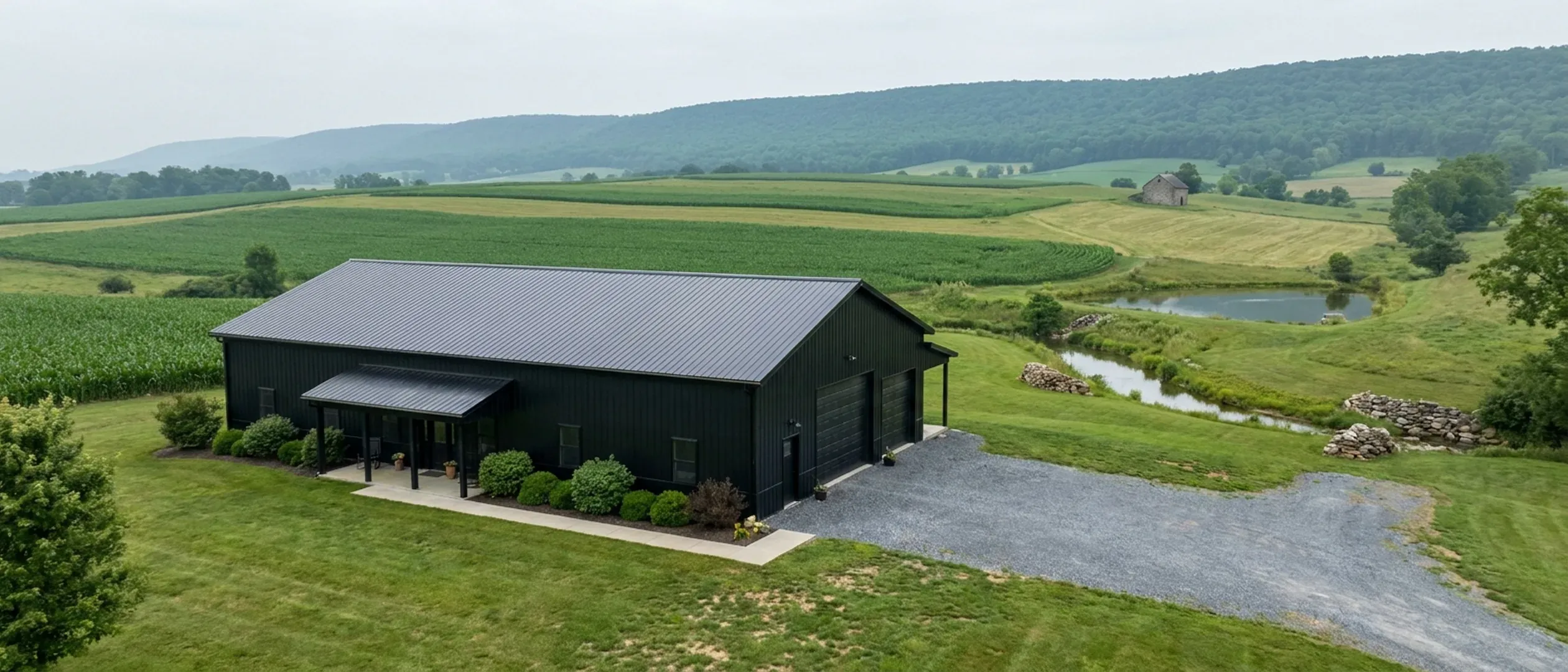
Cost to Build a Barndominium in Pennsylvania
Nobody publishes a measured cost for building a barndominium in Pennsylvania, and a page that hands you one statewide price per square foot is guessing. What does exist is better than a guess. The Census Bureau measures what owners pay a general contractor to build a house on land they already own, and it reports the Northeast region, which includes Pennsylvania, on its own. The Census Bureau also counts every new house authorized by a Pennsylvania building permit and the value of construction reported on those permits. USDA publishes what an acre of Pennsylvania cropland and pasture is worth. This guide sets those figures side by side, each with its source, and then walks through the Pennsylvania site costs that move a rural budget more than the building does: the on-lot sewage permit and soil testing, earth disturbance on a sloped or wooded lot, basements and frost-depth footings, and the loads your municipality designs to. None of it is our pricing, and none of it is a quote.
Figures below are industry data from cited third-party sources, not a quote from Pennsylvania Barndominium Builders. Every project is priced individually.
Bottom Line Up Front
- The Census Bureau's contractor-built series, a house built by a general contractor on the owner's own land, put the Northeast region at a median of $179.30 and an average of $246.26 per square foot for houses started in 2025, land excluded. That is the closest published measure of how a barndominium on acreage is actually bought.
- At those Census rates, 2,000 square feet works out to roughly $359,000 at the median and $493,000 at the average, before land, the well, the on-lot sewage system and the driveway. USDA NASS puts 2026 Pennsylvania pasture at $4,350 and cropland at $9,800 an acre.
- The steel or pole barn shell changes the framing and exterior lines of the budget. The interior, the mechanical systems and the site work cost what they cost on any house, and in Pennsylvania the site work (soil testing, sewage, earth disturbance on a slope, a basement or frost-depth footings) is where rural budgets most often move.
Barndominium cost per square foot: the published figures
Third-party and government figures, each with its source. None of them is a quote, and none of them is ours.
| Measure | Range | Source |
|---|---|---|
| Contractor-built houses on the owner's land, Northeast region, started in 2025: median to average contract price (land excluded) | $179–$246 per sq ft | U.S. Census Bureau, Characteristics of New Housing 2025, Median and Average Contract Price per Square Foot of New Contractor-Built Single-Family Houses Started: Northeast median $179.30, average $246.26 (read 26 Sep 2026) — https://www.census.gov/construction/chars/xls/contractpricesqft_cust.xls |
| New detached houses sold by builders, Northeast region, 2025: median to average sales price (lot excluded) | $233–$278 per sq ft | U.S. Census Bureau, Characteristics of New Housing 2025, Median and Average Price per Square Foot of Floor Area in Detached New Single-Family Houses Sold: Northeast median $232.57, average $277.66 (read 26 Sep 2026) — https://www.census.gov/construction/chars/xls/soldpricesqft_cust.xls |
| Average construction cost alone (no lot, overhead, marketing or profit), national builder survey, 2024 | $162 per sq ft | NAHB, Cost of Constructing a Home 2024 (Eric Lynch, 20 Jan 2025): average construction cost $428,215, about $162 per square foot; national averages only (read 26 Sep 2026) — https://www.nahb.org/-/media/NAHB/news-and-economics/docs/housing-economics-plus/special-studies/2025/special-study-cost-of-constructing-a-home-2024-january-2025.pdf |
| Value of construction reported on Pennsylvania building permits for new single-family houses, 2025 (average per house) | $333,000 per house | U.S. Census Bureau, Building Permits Survey, annual 2025, State Units and State Value tables: Pennsylvania 15,812 one-unit houses valued at $5,266,165 thousand; arithmetic, rounded to the nearest $1,000 (read 26 Sep 2026) — https://www.census.gov/construction/bps/xls/stateannual_202599.xls |
| Pennsylvania agricultural land, 2026 state average: pasture to cropland | $4,350–$9,800 per acre | USDA NASS, Land Values 2026 Summary (released July 31, 2026): Pennsylvania pasture $4,350, cropland $9,800 per acre (read 26 Sep 2026) — https://www.nass.usda.gov/Publications/Todays_Reports/reports/land0726.pdf |
What a 1,500, 2,000, 2,400 or 3,000 sq ft build costs at those rates
Rough totals at common sizes. These move with everything on this page, so treat them as a starting orientation, not an estimate for your project.
1,500 sq ft
$269,000–$369,000
Arithmetic, rounded to the nearest $1,000: 1,500 sq ft × the Census 2025 Northeast contract price per sq ft for contractor-built houses ($179.30 median, $246.26 average), land excluded — https://www.census.gov/construction/chars/xls/contractpricesqft_cust.xls
2,000 sq ft
$359,000–$493,000
Arithmetic, rounded to the nearest $1,000: 2,000 sq ft × the Census 2025 Northeast contract price per sq ft for contractor-built houses ($179.30 median, $246.26 average), land excluded — https://www.census.gov/construction/chars/xls/contractpricesqft_cust.xls
2,400 sq ft
$430,000–$591,000
Arithmetic, rounded to the nearest $1,000: 2,400 sq ft (a 40x60 footprint) × the Census 2025 Northeast contract price per sq ft for contractor-built houses ($179.30 median, $246.26 average), land excluded — https://www.census.gov/construction/chars/xls/contractpricesqft_cust.xls
3,000 sq ft
$538,000–$739,000
Arithmetic, rounded to the nearest $1,000: 3,000 sq ft × the Census 2025 Northeast contract price per sq ft for contractor-built houses ($179.30 median, $246.26 average), land excluded — https://www.census.gov/construction/chars/xls/contractpricesqft_cust.xls
What actually moves the number
The finish schedule, not the frame
NAHB's 2024 survey puts interior finishes at 24.1% of construction cost and the plumbing, electrical and HVAC rough-ins at another 19.2%. A barndominium needs the same cabinets, flooring, drywall and mechanical systems as any other house, so the finishes you choose move the total more than the steel or pole barn shell does.
Sewage and water on rural land
The Census Bureau reports that 58% of contractor-built houses completed in the Northeast in 2025 were on an individual septic system, and 49% had both a septic system and their own water supply. In Pennsylvania the on-lot system is permitted by the local agency's Sewage Enforcement Officer after soil testing, and where the soil or water table rules out a conventional trench or bed, Penn State Extension notes the drain field becomes an elevated sand mound.
Basement, slab or crawl space
In the Northeast, 60% of contractor-built houses completed in 2025 had a full or partial basement, 22% a slab and 17% a crawl space (Census Bureau). Many barndominiums are designed on a slab, but a Pennsylvania lot still needs footings below the frost depth your municipality's code official sets. NAHB puts excavation, foundation, concrete and backfill at 10.0% of construction cost nationally.
Slope, trees and earth disturbance
Clearing and grading a wooded or sloped lot is site work that happens before any building arrives. Pennsylvania requires erosion and sediment controls on every earth disturbance, a written E&S plan once disturbance reaches 5,000 square feet, and an NPDES construction stormwater permit at one acre or more (25 Pa. Code Chapter 102). The driveway, pad and drain field all count toward the disturbed area.
How much does a barndominium cost in Pennsylvania?
Most cost-per-square-foot numbers online are national, unsourced, or describe tract houses on finished subdivision lots. The Census Bureau's contractor-built series avoids all three problems, and the Pennsylvania permit data adds a state-level check.
It measures the way a barndominium is usually bought
The Census contractor-built category is a house built by a general contractor for owner occupancy on the owner's land, which is how a barndominium on acreage is normally built. The Census Bureau excludes the value of the improved lot from the contract price, so the figure is the building alone.
It reports the Northeast, and Pennsylvania is in it
The Census Bureau publishes this series by region, not by state. For houses started in 2025 it reports a Northeast median of $179.30 and an average of $246.26 per square foot. The sample is small in this region: the Census Bureau's relative standard error is 10% on that median and 20% on the average, so read the pair as a range, not two precise points.
Why the median and the average are so far apart
An average is pulled up by a few very large or very finished houses, and the median is not. The Census Bureau's Northeast median contract price for a contractor-built house started in 2025 was $431,100 against an average of $745,900. For planning a mid-range build, start from the median and treat the average as what a high finish level looks like.
The Pennsylvania permit check
The Census Bureau's Building Permits Survey counted 15,812 new single-family houses authorized by Pennsylvania permits in 2025, with a reported construction value of $5,266,165 thousand, which works out to about $333,000 per house. For the Middle Atlantic division as a whole, the same arithmetic on the Census table gives about $338,000. A permit valuation is the construction value the applicant reports, without land, so it is a cross-check rather than a price.
Barndominium cost per square foot: what the shell actually changes
NAHB's 2024 Cost of Constructing a Home survey splits the average construction cost of $428,215 (about $162 per square foot, national) into stages. Only some of them depend on whether the frame is steel, pole barn (post-frame) or conventional.
Framing and exterior: about 30% of construction cost
NAHB puts framing including the roof at 11.6%, trusses at 3.0% and the whole framing stage at 16.6%, with exterior finishes (wall finish 5.7%, roofing 3.9%, windows and doors 3.7%) at 13.4%. That is the part of the budget a steel or pole barn shell competes on.
Everything else: about 70% that does not care about the frame
Foundations are 10.5%, the plumbing, electrical and HVAC rough-ins 19.2%, interior finishes 24.1%, site work 7.6% and final steps such as landscaping and the driveway 6.5% in the NAHB survey. A cheaper shell cannot move these lines, which is why a finished barndominium lands close to a finished house of the same size and specification.
Steel framing is rare in the Northeast data
Of the contractor-built houses the Census Bureau counted as completed in the Northeast in 2025, 97% were wood-framed and steel framing was under half a percent. There are few steel-frame sales for an appraiser to compare against, which matters when a lender sets the loan amount on the appraised value. See the financing guide.
Permit and design fees are a small, real line
NAHB's national survey puts building permit fees at 1.8% of construction cost and architecture and engineering at 1.5%. In Pennsylvania the permit fee comes from your municipality or its third-party agency, and the sewage permit and soil testing are separate from the building permit.
What land costs in Pennsylvania
The contract price excludes land, so the land line has to come from somewhere else. USDA's annual survey is the only statewide published measure.
USDA's 2026 Pennsylvania figures
USDA NASS reports Pennsylvania cropland at $9,800 an acre and pasture at $4,350 an acre for 2026, both up about 2.5% from 2025. USDA's farm real estate figure, which includes the buildings on farms, averaged $8,700 an acre. These are statewide agricultural averages; a wooded lot near Pittsburgh, Lancaster or the Poconos is priced by its own market.
A finished subdivision lot is a different product
NAHB's national survey puts the average finished lot at $91,057, 13.7% of the sales price of a builder's home. A finished lot arrives with sewer, water and a road. Raw acreage does not, and the sewage system, well, driveway and utility line are then yours to budget.
Check the tax status before you buy
Farmland enrolled in Clean and Green is taxed on its use value. Splitting off a house lot or changing the use can trigger roll-back taxes, up to seven years of tax savings plus 6% interest, so the county assessment office is worth a call before the purchase agreement is signed.
Costs that sit outside the contract price
These are the lines that make two identical buildings on two Pennsylvania parcels cost very different amounts. None of them has a statewide published price.
On-lot sewage system
Penn State Extension reports that about 25 percent of all housing units in Pennsylvania use on-lot septic systems. The soil tests the SEO requires decide the system type, and a sand mound costs more than a conventional in-ground bed. Get the soil evaluation done before you commit to a house plan; see site preparation.
Well and water
Water-well drillers in Pennsylvania are licensed by the state (Department of Conservation and Natural Resources); some counties and municipalities also require a well permit. Depth, and therefore cost, depends on the geology under your parcel, so the driller's quote is the only figure worth using.
Driveway and access
A long driveway is earth disturbance, stone and sometimes a culvert. If it meets a state highway, the municipality will not issue the building permit without noting that a PennDOT highway occupancy permit is required, so that step belongs in the schedule and the budget.
Permits, inspections and engineering
The building permit, the third-party inspections where your municipality uses them, the sewage permit and any engineering for the design loads are each separate items. Our permitting service lays them out for your parcel before you commit.
Reading this because you are weighing a build? The next step is a plan drawn for your program.
What's different about Pennsylvania
The on-lot sewage permit comes first
Where there's no public sewer, the lot needs an on-lot sewage permit from the local agency's Sewage Enforcement Officer (SEO): the municipality, a joint local agency, or in some counties the county health department. Before a permit is issued the soil is tested, with a soil profile pit and, where the soils allow, percolation tests (25 Pa. Code § 73.14). The result decides whether the drain field is a conventional trench or bed or a larger system such as a sand mound, and that is a real budget line decided by the land, not by the building. We never price or design the septic system; the SEO and a septic designer do.
Design loads are set by your municipality
Under the Uniform Construction Code, the building code official determines the climatic and geographic design criteria in Table R301.2(1) of the 2021 International Residential Code for residential work (34 Pa. Code § 403.103(d)). Frost depth, ground snow load and design wind speed are therefore local numbers, not Pennsylvania-wide ones. They set how deep the footings go and how the roof framing is engineered across a wide clear span, so ask for your municipality's table before you compare kit or shell prices.
Who inspects, and who you pay
More than 90% of Pennsylvania's 2,562 municipalities administer the Uniform Construction Code themselves, with their own staff or a third-party agency they retain. Where a municipality has opted out, the permit applicant for a house hires a certified third-party agency for the plan review and five inspections: foundation; plumbing, mechanical and electrical; frame and masonry; wallboard; and final. Permit and inspection fees are set by the municipality or the agency, so the only reliable figure is the fee schedule for your parcel.
Earth disturbance thresholds
Pennsylvania requires erosion and sediment controls on every earth disturbance; a written E&S plan once disturbance reaches 5,000 square feet, and an NPDES construction stormwater permit, administered with the county conservation district, at one acre or more (25 Pa. Code §§ 102.4 and 102.5). The municipality's stormwater ordinance applies on top of that. On a long rural driveway the disturbed area adds up faster than most owners expect.
Clean and Green land
If the land is enrolled in Pennsylvania's Clean and Green preferential assessment program, splitting off a house lot or changing the land's use can trigger roll-back taxes, up to seven years of tax savings plus 6% interest. Ask the county assessment office before you buy or subdivide, because that bill belongs in the land budget.
How much does a barndominium cost to build in Pennsylvania?
What is the barndominium cost per square foot?
How much does a 1,500 sq ft barndominium cost?
How much does a 3,000 sq ft barndominium cost?
Is a barndominium cheaper to build than a house in Pennsylvania?
Can a barndominium be built as an agricultural building to skip the code?
How much does a septic system cost in Pennsylvania?
Do you publish your own prices?
Questions answered? Tell us what you want to build and we will put real numbers against it.
Sources
- U.S. Census Bureau — Median and Average Contract Price per Square Foot of New Contractor-Built Single-Family Houses Started (Characteristics of New Housing, 2025) — Northeast 2025: median $179.30 (RSE 10%), average $246.26 (RSE 20%) per sq ft, lot excluded. Read 26 Sep 2026.
- U.S. Census Bureau — Median and Average Contract Price of New Contractor-Built Single-Family Houses Started — Northeast 2025: median $431,100, average $745,900. Read 26 Sep 2026.
- U.S. Census Bureau — Median and Average Price per Square Foot of Floor Area in Detached New Single-Family Houses Sold — Northeast 2025: median $232.57, average $277.66, lot excluded. Read 26 Sep 2026.
- U.S. Census Bureau — Type of Sewage System by Water Supply Source, Contractor-Built Houses Completed — Northeast 2025: individual septic 58%; septic and individual water 49%. Read 26 Sep 2026.
- U.S. Census Bureau — Type of Foundation, Contractor-Built Houses Completed — Northeast 2025: full or partial basement 60%, slab 22%, crawl space 17%. Read 26 Sep 2026.
- U.S. Census Bureau — Type of Framing, Contractor-Built Houses Completed — Northeast 2025: wood 97%, steel under 0.5%. Read 26 Sep 2026.
- U.S. Census Bureau — Building Permits Survey, annual 2025, units and valuation by state — Pennsylvania 1-unit: 15,812 houses, $5,266,165 thousand. Read 26 Sep 2026.
- NAHB — Cost of Constructing a Home 2024 (Eric Lynch, 20 Jan 2025) — Average construction cost $428,215, about $162 per sq ft; stage shares from Table 3. National averages only. Read 26 Sep 2026.
- USDA NASS — Land Values 2026 Summary (July 2026) — Pennsylvania 2026: farm real estate $8,700, cropland $9,800, pasture $4,350 per acre. Read 26 Sep 2026.
- 25 Pa. Code Chapter 73 — Standards for Onlot Sewage Treatment Facilities — § 73.14: soil tests before permit issuance. Read 26 Sep 2026.
- 25 Pa. Code Chapter 102 — Erosion and Sediment Control — § 102.4(b): E&S plan at 5,000 sq ft; § 102.5(a): NPDES permit at 1 acre. Read 26 Sep 2026.
- 34 Pa. Code Chapter 403 — Uniform Construction Code Administration — § 403.103(d): the building code official determines the Table R301.2(1) design criteria. Read 26 Sep 2026.
- Pennsylvania Department of Labor & Industry — Uniform Construction Code — Opt-in and opt-out administration; third-party agencies in opted-out municipalities. Read 26 Sep 2026.
- Penn State Extension — Septic System Basics — Sand mounds where soil is unsuitable or the water table too high for a trench or bed. Updated 16 Sep 2024; read 26 Sep 2026.
- Penn State Extension — Managing Your On-Lot Septic System — About 25 percent of Pennsylvania housing units use on-lot septic systems. Updated 20 Oct 2023; read 26 Sep 2026.
- Pennsylvania Farmland and Forest Land Assessment Act of 1974 (Clean and Green), Act 319 — Roll-back taxes: up to seven years plus 6% interest. Read 26 Sep 2026.
Keep reading
The pages that answer the next question this one raises.
Barndominium vs. house cost
The same NAHB cost stages, compared for a steel or pole barn shell and a conventionally framed house.
Read itHow big a barndominium your budget builds
Working backward from a budget to square footage, after land and site costs come off the top.
Read itBarndominium financing in Pennsylvania
Construction-to-permanent loans, USDA Rural Development and PHFA, and why the appraisal matters.
Read itSite preparation
Clearing, grading, the pad and the driveway, planned around the soil test and the E&S rules.
Read itStart the survey
Tell us about your land and what you want to build.
Read itWant a real number instead of a range?
Start the survey and tell us about your land and what you want to build. Include the municipality and parcel ID if you have them, because in Pennsylvania the township or borough, the slope, and the sewage and well answers change the budget more than the building does. The survey costs nothing.