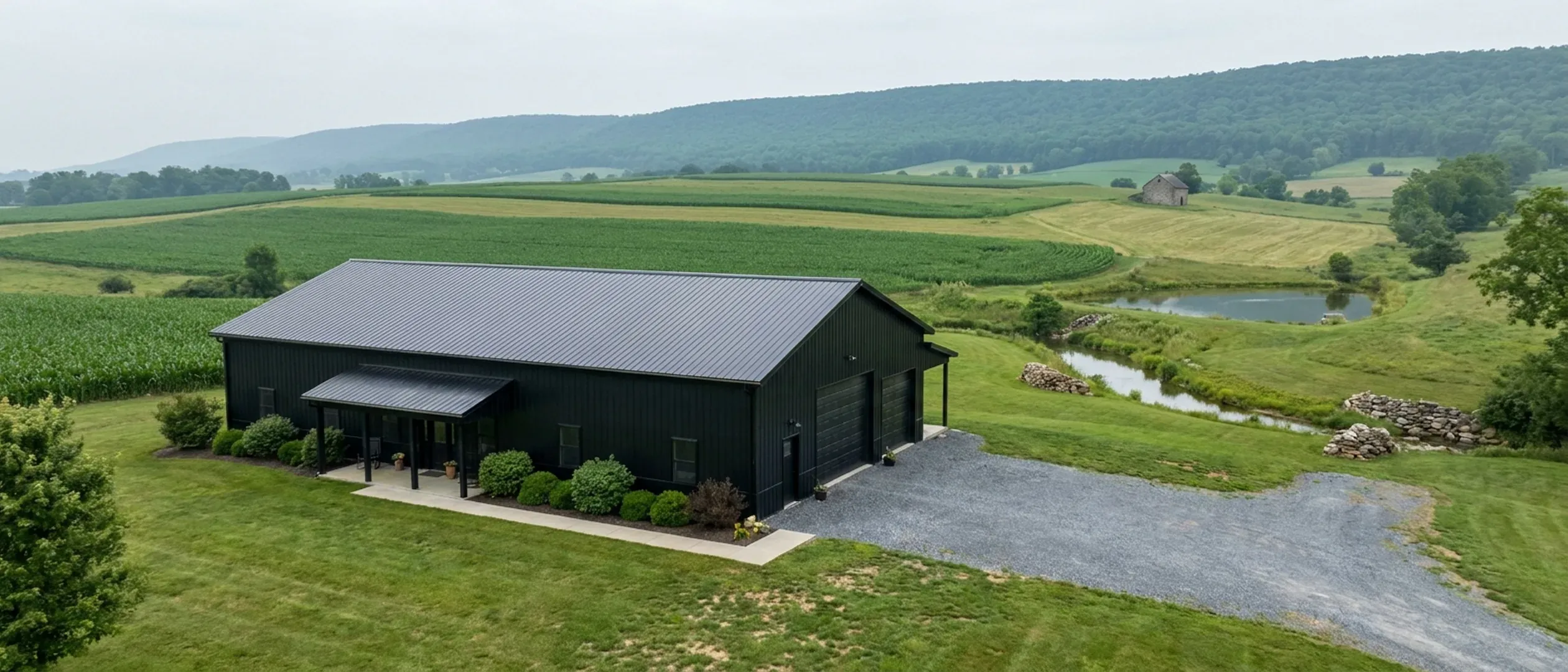
Barndominium Financing in Pennsylvania: Construction Loans, USDA and PHFA
A barndominium is financed the way any custom house on your own land is financed: with a construction loan that pays the builder in draws and then becomes, or is replaced by, a permanent mortgage. What makes it harder is not the word barndominium but the appraisal. Lenders lend against the appraised value, and in the Northeast almost every new house is wood-framed, so a steel or pole barn house has few comparable sales. This guide sets out the loan structures and the Pennsylvania programs from their own published rules: Fannie Mae's single-closing construction-to-permanent terms, USDA Rural Development's Section 502 direct and guaranteed loans, the Pennsylvania Housing Finance Agency's first mortgages, and the Farm Credit lender that serves Pennsylvania. Rates are dated, because they change weekly. None of this is financial advice, and we are not a lender.
Figures on this page are cited third-party or government data, not a quote from Pennsylvania Barndominium Builders.
Bottom Line Up Front
- Most owner-built houses are financed with a construction-to-permanent loan. Under Fannie Mae's rules for a single-closing loan, no construction period may exceed 12 months, the total may not exceed 18, and the loan converts automatically to a permanent mortgage of up to 30 years.
- USDA Rural Development's Section 502 programs can finance building a house in an eligible rural area: the direct loan's rate was 5.250% effective September 1, 2026, and the guaranteed program offers 100% financing through approved lenders for qualifying incomes.
- The appraisal is the real hurdle. The Census Bureau counted 97% of contractor-built houses completed in the Northeast in 2025 as wood-framed, so talk to the lender about comparables before the design is final.
What actually moves the number
The appraisal sets the loan
Fannie Mae's single-closing rules size the loan against the as-completed appraised value of the lot and improvements. If the appraiser finds few comparable steel or pole barn houses, the value, and therefore the loan, can come in below the cost to build, and the gap is paid in cash.
The rate on the day you lock
Freddie Mac's Primary Mortgage Market Survey put the average 30-year fixed rate at 7.03% for the week of September 24, 2026, against 6.30% a year earlier; the 15-year averaged 6.42%. A construction loan's rate and lock terms are set by the lender, so compare them in writing.
Owning the land already
Under Fannie Mae's single-closing rules, a borrower who already owns the lot is treated as a limited cash-out refinance and the loan is measured against the as-completed value of lot and house. Land you own outright can therefore count toward the equity the lender wants to see.
Complete plans and permits
A construction lender funds a defined project. Expect to provide drawings, a contract and a budget, and in Pennsylvania the on-lot sewage permit from the local agency's Sewage Enforcement Officer comes before the building permit, so it is usually on the lender's list too.
How a construction-to-permanent loan works
The structure below is Fannie Mae's, from its Selling Guide topic B5-3.1-02 dated 05/06/2026. Individual lenders add their own overlays.
One closing, two phases
In a single-closing transaction the loan documents set the permanent terms at the start, so the construction loan automatically converts to a long-term mortgage when construction is complete. The lender manages the draws to the builder and suppliers during construction.
The construction clock
Fannie Mae allows no single construction period of more than 12 months and no more than 18 months in total, with no exceptions. A project that runs longer has to be handled as a two-closing transaction, which means a separate permanent loan and a second set of closing costs.
How the loan is sized
If you already own the lot, the loan is measured against the as-completed appraised value of lot and improvements. If you are buying the lot as part of the deal, it is measured against the lesser of the total cost (construction plus lot) or the as-completed appraised value.
Two closings instead
Some owners use a short-term construction loan and then a separate mortgage. It gives more flexibility on schedule, at the cost of two closings and the risk that rates move before the second one.
USDA Rural Development Section 502 loans
Both Section 502 programs can finance building a house in an eligible rural area. The rules quoted here are from USDA's program pages and 7 CFR Parts 3550 and 3555.
Direct loans (low and very low income)
USDA lends directly to applicants at or below the low-income limit for the area. Funds can be used to build, repair, renovate or relocate a home, or to purchase and prepare sites, including water and sewage facilities. The rate was 5.250% effective September 1, 2026, can be reduced by payment assistance to as low as 1%, and the payback period is up to 33 years (38 for some very low income applicants).
Guaranteed loans (up to 115% of median income)
An approved lender makes the loan and USDA guarantees 90% of it, allowing 100% financing to buy, build, rehabilitate, improve or relocate a dwelling in an eligible rural area. Loan funds may also cover site preparation, including grading, foundation, driveways and walks (7 CFR 3555.101).
The site and the house must qualify
The guaranteed program's site must not be used primarily for agriculture, farming or commercial enterprise, must have direct access from a hard-surfaced or all-weather road, and must have adequate water and wastewater systems (7 CFR 3555.201). A direct-loan house must be modest for the area and not designed for income-producing purposes, and an in-ground pool with new construction is prohibited (7 CFR 3550.57).
You stay involved during construction
For a direct loan used to build, an adult member of the household must be available to make inspections and authorize progress payments as the dwelling is constructed (7 CFR 3550.53).
PHFA and conventional first mortgages
The Pennsylvania Housing Finance Agency's published loan programs, as they appeared on its Home Purchase Loans page in May 2026.
HFA Preferred
A 30-year fixed conventional loan with income limits by county, no first-time buyer requirement, a minimum of $1,000 of the borrower's own funds according to PHFA, and required homebuyer education. The loan must be for a primary residence.
Keystone Home Loan
For first-time buyers, veterans, or buyers in targeted counties and areas, with income and purchase price limits. PHFA lists minimum investments of 3% to 5% for its insured conventional loans and 3.5% for FHA, and says VA and Rural Development loans require no down payment in most cases.
Keystone Government Loan
PHFA first mortgage financing on FHA, VA and Rural Development loans, underwritten to the federal agency's guidelines with no PHFA-specific income or price limit. Not every participating lender offers every loan type.
What owners actually use
The Census Bureau's 2025 data for contractor-built houses started in the Northeast show 74% financed with conventional loans and 26% paid in cash, with FHA and VA shares rounding to zero. For a custom house on your own land, a conventional construction loan is the norm.
Reading this because you are weighing a build? The next step is a plan drawn for your program.
What's different about Pennsylvania
USDA Rural Development covers much of Pennsylvania
Section 502 loans are made only in areas USDA designates as rural, which you check address by address on USDA's eligibility map. The Pennsylvania Housing Finance Agency notes that Rural Development loans are not available in Philadelphia County or Delaware County and other major cities, so the rural parcels a barndominium is usually built on are the ones to check.
PHFA lends through participating lenders
The Pennsylvania Housing Finance Agency offers first mortgages (HFA Preferred, the Keystone Home Loan and Keystone Government Loan) through a network of participating lenders, with PHFA servicing the loan. Its published programs are home purchase loans; whether a participating lender will use one as the permanent loan on a new build is a question for that lender.
Land you have owned for two years
For PHFA's Keystone Home Loan, the purchase price limit includes all costs for a complete home, but PHFA states that the appraised value of land owned outright for more than two years does not need to be included. That matters to anyone building on family land or a parcel bought years ago.
Farm Credit in Pennsylvania
The Farm Credit institutions listed for Pennsylvania are AgFirst Farm Credit Bank, CoBank and Horizon Farm Credit. Horizon publishes one-time-close construction loans with a 12-month interest-only construction period, fixed rates for up to 30 years, and financing for properties with excess acreage and additional buildings. Its published list names stick-built, modular and log homes, so ask directly how it treats a steel or pole barn house.
Can you get a mortgage for a barndominium in Pennsylvania?
What is a construction-to-permanent loan?
Can I use a USDA loan to build a barndominium?
What is the USDA direct loan rate right now?
Does PHFA finance new construction?
What are mortgage rates today?
Why might my barndominium appraise below cost?
Questions answered? Tell us what you want to build and we will put real numbers against it.
Sources
- Fannie Mae Selling Guide B5-3.1-02 — Conversion of Construction-to-Permanent Financing: Single-Closing Transactions — Topic dated 05/06/2026; 12-month / 18-month construction periods; 30-year term; loan-to-value basis. Read 26 Sep 2026.
- Freddie Mac — Primary Mortgage Market Survey, historical data — 30-year fixed 7.03% and 15-year 6.42% (week of 9/24/2026); 30-year 6.30% (week of 9/25/2025). Read 26 Sep 2026.
- USDA Rural Development — Single Family Housing Direct Home Loans in Pennsylvania — Rate 5.250% effective September 1, 2026; uses include building a home; up to 33-year payback. Read 26 Sep 2026.
- USDA Rural Development — Single Family Housing Guaranteed Loan Program — 100% financing; 90% guarantee; income up to 115% of median; purchase, build, rehabilitate. Read 26 Sep 2026.
- 7 CFR 3550.52, 3550.53 and 3550.57 — Section 502 direct loan purposes, eligibility and dwelling requirements (eCFR) — Funds may be used to build; inspections during construction; modest dwelling; no in-ground pool with new construction. eCFR current as of 24 Sep 2026.
- 7 CFR 3555.101 and 3555.201 — Guaranteed loan purposes and site requirements (eCFR) — Construction of a new dwelling; site preparation; site not primarily agricultural or commercial; all-weather road; adequate water and wastewater. eCFR current as of 24 Sep 2026.
- Pennsylvania Housing Finance Agency — Home Purchase Loans (Internet Archive capture of 15 May 2026) — HFA Preferred, Keystone Home Loan and Keystone Government Loan terms; land owned more than two years; Rural Development availability. Archive copy dated 15 May 2026, read 26 Sep 2026.
- Farm Credit — Pennsylvania — Farm Credit institutions in Pennsylvania: AgFirst Farm Credit Bank, CoBank, Horizon Farm Credit. Read 26 Sep 2026.
- Horizon Farm Credit — Home Construction Loans — One-time close; 12-month interest-only construction; fixed rates up to 30 years; stick-built, modular or log homes; excess acreage. Read 26 Sep 2026.
- U.S. Census Bureau — Number of Contractor-Built Houses Started by Type of Financing — Northeast 2025: conventional 74%, cash 26%. Read 26 Sep 2026.
- U.S. Census Bureau — Type of Framing, Contractor-Built Houses Completed — Northeast 2025: wood 97%, steel under 0.5%. Read 26 Sep 2026.
- Pennsylvania Sewage Facilities Act (Act 537) — On-lot sewage permit from the local agency before installing or occupying a building. Read 26 Sep 2026.
Keep reading
The pages that answer the next question this one raises.
Cost to build a barndominium in Pennsylvania
What the loan has to cover: published cost per square foot, land and site costs.
Read itBarndominium vs. house cost
Why the frame matters less than the finish, and what it means for the appraisal.
Read itTurnkey builds
One contract for the whole build, with the drawings and budget a construction lender asks for.
Read itStart the survey
Tell us about your land, your budget and how you plan to finance it.
Read itWant a real number instead of a range?
Start the survey and tell us about your land and what you want to build. Include the municipality and parcel ID if you have them, because in Pennsylvania the township or borough, the slope, and the sewage and well answers change the budget more than the building does. The survey costs nothing.