Barndominium Site Preparation in Pennsylvania
Site preparation is everything that happens to your Pennsylvania land before the foundation goes in: clearing, the entrance and driveway, the building pad, drainage and the erosion controls that keep soil on the site. On a typical rural parcel here that means trees, a slope and ground that can hide rock, wet spots, limestone or old mine workings. It is also where the order of approvals matters most, because the sewage soil tests and the erosion rules come before the bulldozer. We plan the site work around all of it, then build the drive and the pad the rest of the house depends on.
Site Preparation: how the work runs
Four stages, in this order. The sequence matters more than it looks: settling who administers the code for your municipality, the sewage soil tests and the site approvals before anything is fabricated is what keeps a Pennsylvania build from stalling.
Read the ground
We start with the mapped soils for your parcel on the NRCS Web Soil Survey, the state's maps of sinkholes and old mines, and a walk of the land to see the slope, the trees and where water runs. Where the ground calls for it, a geotechnical firm tests it and a licensed land surveyor marks the boundaries and setbacks.
Sewage testing and siting
Where there is no public sewer, the lot needs an on-lot sewage permit from the local agency's Sewage Enforcement Officer, and the soil is tested first: a soil profile pit and, where the soils allow, percolation tests. The house, the driveway and the well are placed around the area that passes.
Erosion controls, clearing and the drive
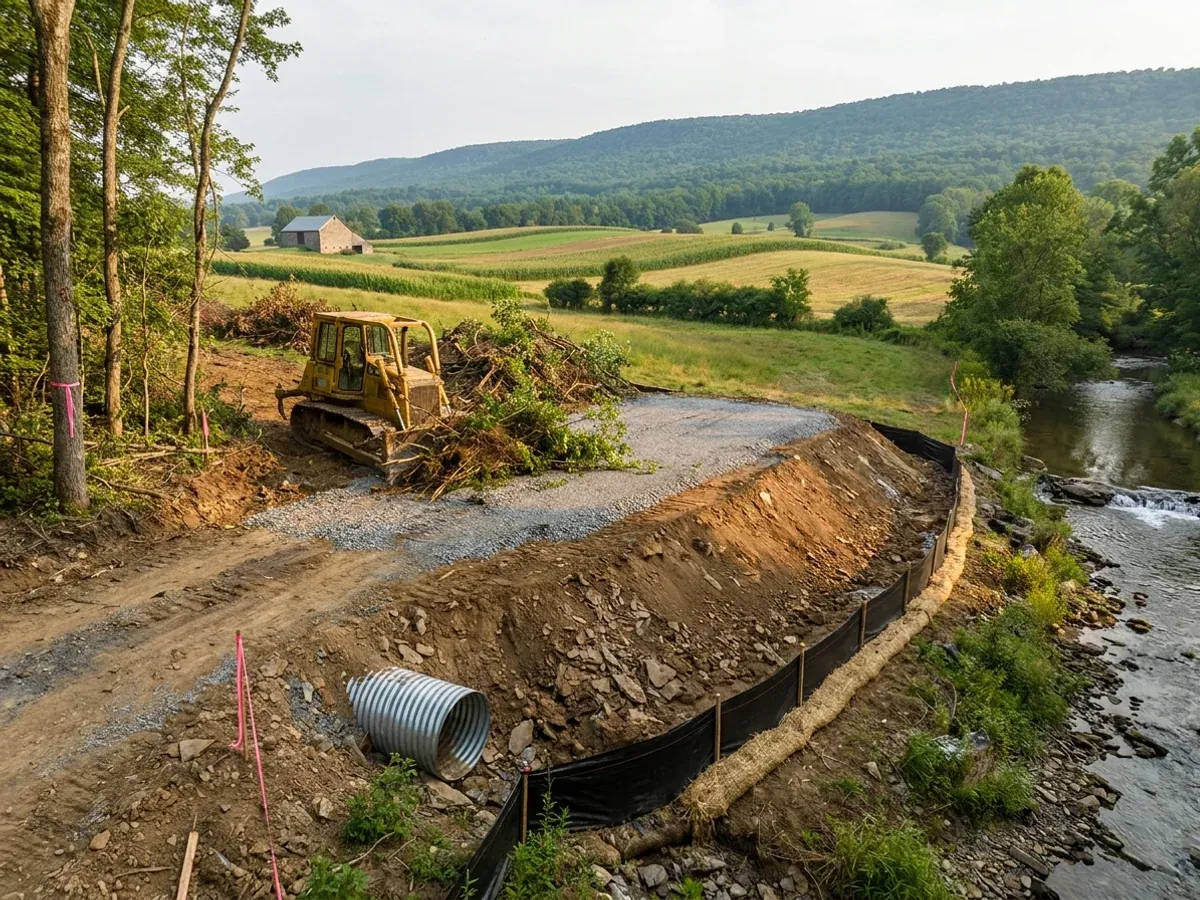
Silt fence and other erosion and sediment controls go in before the ground is opened. Then the building area is cleared, and a driveway is built that a concrete truck and a loaded delivery can climb in wet weather. A new entrance onto a state highway needs a PennDOT highway occupancy permit.
Pad, drainage and handover
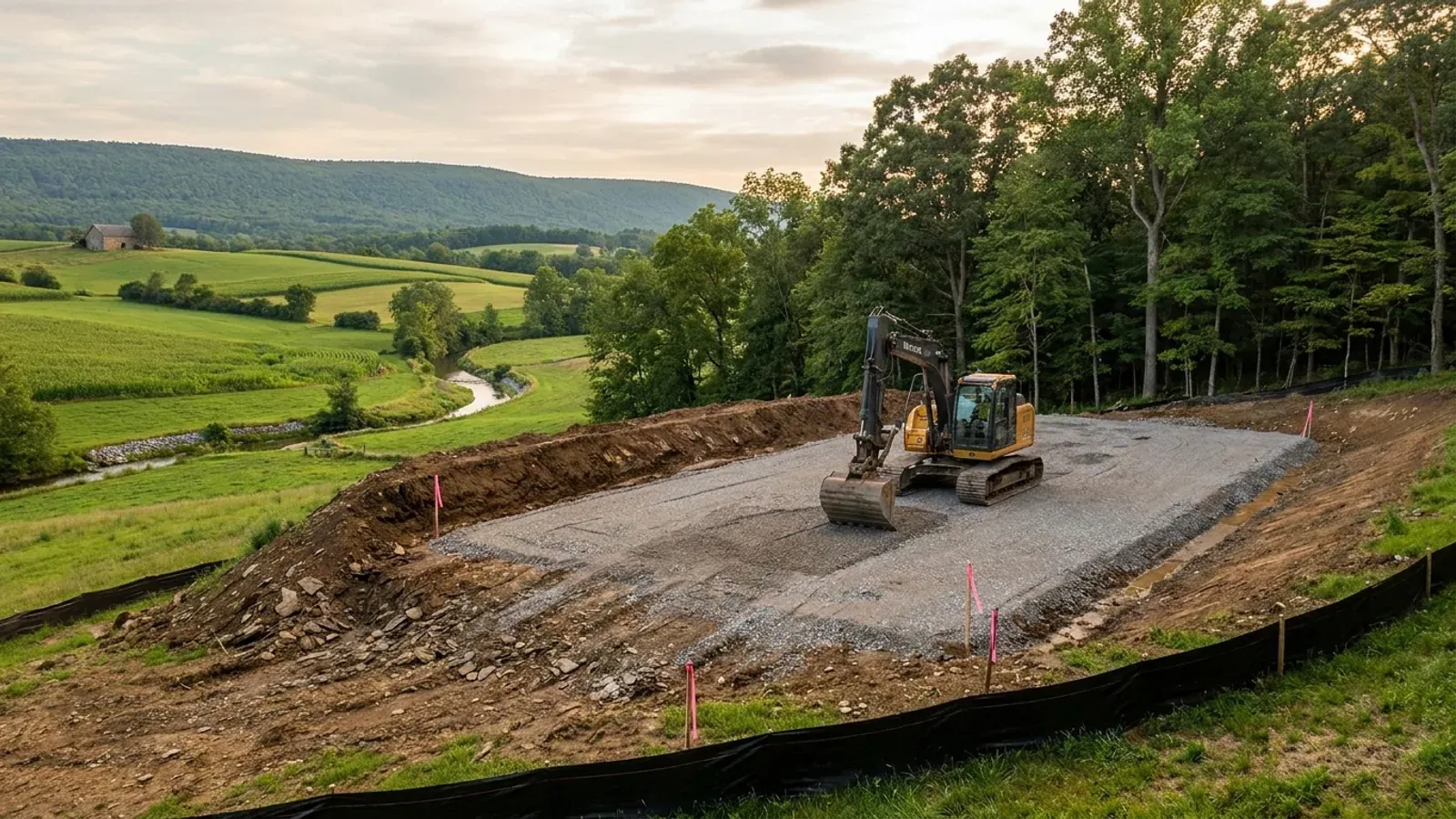
The pad is cut or filled, built up in compacted layers and shaped so water runs away from the building. On a slope that can mean a stepped pad, swales and a drain above the house to carry uphill water around it.
Most Pennsylvania building lots start in the woods, on a hill
The Department of Conservation and Natural Resources reports that forests cover more than 60 percent of Pennsylvania and that about 70 percent of that forest is privately owned. Much of the land that comes up for sale is wooded and sloping, and some of it sits on limestone prone to sinkholes or over abandoned coal and clay mines. Finding those things at the site stage costs a little; finding them under a finished slab costs a great deal.
Where we deliver site preparation
In Pennsylvania the line that matters is the municipal boundary. The building code is the same everywhere, but each of the 2,562 cities, boroughs and townships decides how it is administered: by its own code office, by an agency it retains, or by opting out and leaving the applicant to hire a certified third-party agency. Cross a township line and what changes is who reviews the drawings, what they charge, how the land is zoned, which Sewage Enforcement Officer tests the soil, and whose snow, wind and frost values the drawings answer to.
Barndominium builders across Pennsylvania.
Every city, borough and county we build in has its own answer on permits, sewage and design values. The service area pages set out who handles each one.
What actually decides the price
Square footage is the number everyone leads with, and it is rarely the one that moves a barndominium budget. These four do.
-
Clearing and access
Mature hardwoods, stumps, a long driveway and a steep climb from the road add machine time, stone and culverts. Open ground near the road is the cheapest site; a wooded ridge at the back of the parcel is not.
-
Slope and rock
Cutting a level pad into a hillside moves a lot of earth, and shallow rock can mean breaking it out. A plan that uses the slope, with a walkout or a stepped slab, can cut this cost sharply.
-
Drainage and erosion controls
Water coming off the hill above the house, wet spots and the controls that keep sediment out of streams during construction are real line items. The more ground that is disturbed, the more controls and paperwork the job carries.
-
What the soil allows for sewage
The soil profile and percolation tests decide what kind of on-lot sewage system the lot can take, if any, and where it goes. That can move the house and change the site budget.
Site Preparation in Pennsylvania: common questions
8 questions we get asked most often about building in Pennsylvania. If yours is not on the list, ask it directly.
Do I need a perc test before I buy land in Pennsylvania?
Who issues the septic permit in Pennsylvania?
Do I need an erosion and sediment control permit to build?
What if my land has sinkholes or limestone?
What if the property is over an old mine?
Do you survey the property?
How much of the land do you clear?
When can site work start?
Sources
- Forests and Trees — Pennsylvania Department of Conservation and Natural Resources
- Sinkholes — Pennsylvania Department of Conservation and Natural Resources
- Mine Subsidence Insurance — Pennsylvania Department of Environmental Protection
- 25 Pa. Code Chapter 102, Erosion and Sediment Control — Pennsylvania Code
- Construction Stormwater (Chapter 102) — Pennsylvania Department of Environmental Protection
- On-lot Disposal System — Pennsylvania Department of Environmental Protection
- Web Soil Survey — USDA Natural Resources Conservation Service
Keep reading
The pages that answer the next question this one raises.
Ready to put site preparation against a real plan? Start there and the rest follows.
Tell us about the land
Tell us where the parcel is and what you want on it, and we will come back with who has jurisdiction, what the land needs before it can be built on, and a realistic budget range. Starting the survey costs nothing.