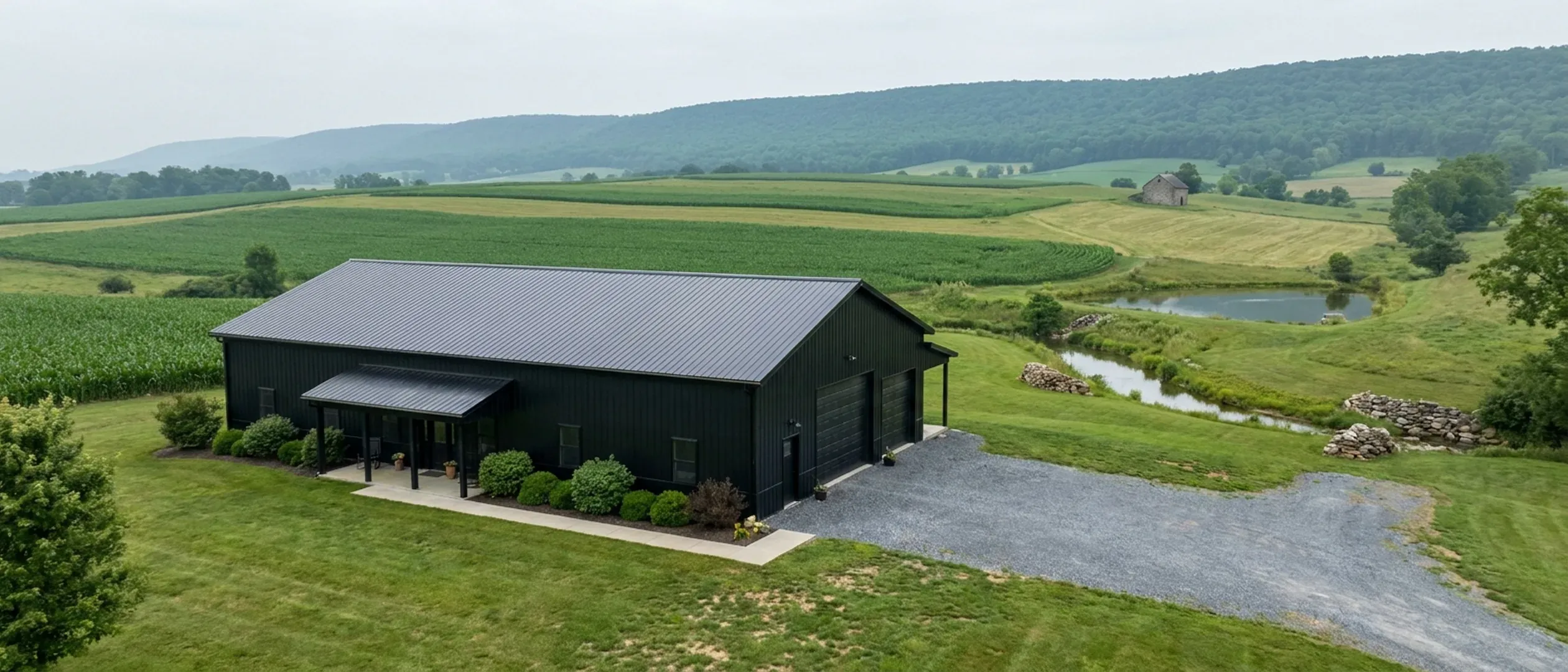
How Big a Barndominium Can You Build on Your Budget in Pennsylvania?
Most people start with a floor plan and ask what it costs. It works better the other way round: start with the budget, take off what the land and the site will cost, and see how much building is left. In Pennsylvania the site lines are large and parcel-specific (the on-lot sewage system the soil test allows, the well, the driveway, clearing a wooded or sloped lot), so they come off the top before anyone draws a plan. What remains can be divided by a published cost per square foot. The figure used here is the Census Bureau's contract price for houses built by a general contractor on the owner's land in the Northeast region, which includes Pennsylvania. The results are arithmetic on a regional figure, not our pricing and not a quote.
Figures below are industry data from cited third-party sources, not a quote from Pennsylvania Barndominium Builders. Every project is priced individually.
Bottom Line Up Front
- Take land, sewage, well, driveway and clearing off the top first. On rural Pennsylvania land those lines depend on the soil test and the lot, and no agency publishes a statewide price for them.
- Divide what is left by the Census Bureau's 2025 Northeast contract price: $179.30 per square foot at the median, $246.26 at the average. At those Census rates, a $400,000 building budget works out to about 2,231 square feet at the median and 1,624 at the average.
- For scale, the Census Bureau's median contractor-built house completed in the Northeast in 2025 was 2,495 square feet. Unheated shop space under the same roof costs far less per square foot than finished living space.
Published cost figures
Third-party and government figures, each with its source. None of them is a quote, and none of them is ours.
| Measure | Range | Source |
|---|---|---|
| Contractor-built houses on the owner's land, Northeast region, started in 2025: median to average contract price (land excluded) | $179–$246 per sq ft | U.S. Census Bureau, Characteristics of New Housing 2025, Median and Average Contract Price per Square Foot of New Contractor-Built Single-Family Houses Started: Northeast median $179.30, average $246.26 (read 26 Sep 2026) — https://www.census.gov/construction/chars/xls/contractpricesqft_cust.xls |
Total cost by size
Rough totals at common sizes. These move with everything on this page, so treat them as a starting orientation, not an estimate for your project.
1,200 sq ft
$215,000–$296,000
Arithmetic, rounded to the nearest $1,000: 1,200 sq ft (a 30x40 footprint) × the Census 2025 Northeast contract price per sq ft for contractor-built houses ($179.30 median, $246.26 average), land excluded — https://www.census.gov/construction/chars/xls/contractpricesqft_cust.xls
1,800 sq ft
$323,000–$443,000
Arithmetic, rounded to the nearest $1,000: 1,800 sq ft × the Census 2025 Northeast contract price per sq ft for contractor-built houses ($179.30 median, $246.26 average), land excluded — https://www.census.gov/construction/chars/xls/contractpricesqft_cust.xls
2,400 sq ft
$430,000–$591,000
Arithmetic, rounded to the nearest $1,000: 2,400 sq ft (a 40x60 footprint) × the Census 2025 Northeast contract price per sq ft for contractor-built houses ($179.30 median, $246.26 average), land excluded — https://www.census.gov/construction/chars/xls/contractpricesqft_cust.xls
3,000 sq ft
$538,000–$739,000
Arithmetic, rounded to the nearest $1,000: 3,000 sq ft × the Census 2025 Northeast contract price per sq ft for contractor-built houses ($179.30 median, $246.26 average), land excluded — https://www.census.gov/construction/chars/xls/contractpricesqft_cust.xls
What actually moves the number
Land and site come off the top
USDA NASS puts 2026 Pennsylvania pasture at $4,350 an acre and cropland at $9,800. On raw land the sewage system, well, driveway and clearing are yours to pay for before the building starts, and their size is set by the parcel.
Finished area, not footprint
A 40x60 building is 2,400 square feet of footprint. If a third of it is an unheated shop, the finished living area is 1,600 square feet, and that is the number the Census cost per square foot should be multiplied by.
Finish level moves the rate
The Census Bureau's 2025 Northeast median ($179.30 per square foot) and average ($246.26) differ by more than a third, largely because of how houses are finished. Interior finishes are 24.1% of construction cost in NAHB's national survey.
Small houses cost more per foot
The kitchen, bathrooms, electrical service and heating system are needed whatever the size, so a smaller house spreads them over fewer square feet. Expect a compact plan to sit toward the upper end of any per-square-foot range.
Step one: take the land and site off the top
The Census contract price excludes the lot, so everything that belongs to the land has to be budgeted before the building.
Land
USDA NASS reports 2026 Pennsylvania averages of $9,800 an acre for cropland and $4,350 for pasture. A buildable residential parcel is priced by its local market, which can be well above an agricultural average.
Sewage and water
The on-lot system is decided by the soil test the Sewage Enforcement Officer requires. Water-well drillers in Pennsylvania are licensed by the state, and some counties and municipalities also require a well permit. Get both quotes before you fix the building budget.
Clearing, grading and the driveway
Pennsylvania requires erosion and sediment controls on every earth disturbance, a written E&S plan once disturbance reaches 5,000 square feet, and an NPDES construction stormwater permit at one acre or more. A long driveway on a wooded slope can reach those lines on its own. See site preparation.
Step two: divide what is left
The sizes below divide a building budget by the Census Bureau's 2025 Northeast contract price per square foot for contractor-built houses: $179.30 at the median and $246.26 at the average. The first figure is at the median, the second at the average.
A $300,000 building budget
About 1,673 square feet at the Census median rate, or 1,218 at the Census average rate. That is roughly a small barndominium to a modest three-bedroom plan.
A $400,000 building budget
About 2,231 square feet at the Census median rate, or 1,624 at the Census average rate.
A $500,000 building budget
About 2,789 square feet at the Census median rate, or 2,030 at the Census average rate. Near the median, that is a finished 40x60 barndominium.
A $600,000 building budget
About 3,346 square feet at the Census median rate, or 2,436 at the Census average rate.
What the typical new house looks like
The Census Bureau also reports the size of the houses in the same series, which is a useful check on a plan.
Median 2,495, average 2,867 square feet
Those are the Census Bureau's 2025 figures for contractor-built houses completed in the Northeast. The relative standard errors are 17% and 11%, so treat them as a rough centre, not a target.
Heated area is what you pay for
An unheated shop, garage or equipment bay under the same roof is simpler to build than finished living space. A shouse with a large shop can look inexpensive per total square foot while the living area costs what living area costs.
Leave room in the budget
Every figure here is a regional statistic. Your parcel's design loads, soil test and finish choices will move the result, so plan a contingency rather than building to the last dollar.
Reading this because you are weighing a build? The next step is a plan drawn for your program.
What's different about Pennsylvania
Test the soil before you size the house
Where there's no public sewer, the lot needs an on-lot sewage permit from the local agency's Sewage Enforcement Officer, and the soil is tested before a permit is issued: a soil profile pit and, where the soils allow, percolation tests. The system the soil allows, and the ground it takes up, decide how much of the budget and the lot is left for the building.
A basement adds area, not just cost
The Census Bureau reports that 60% of contractor-built houses completed in the Northeast in 2025 had a full or partial basement. If you compare a slab barndominium with a house that has one, compare cost per usable square foot, and remember footings go below the frost depth your municipality's code official sets either way.
Wider spans cost more to engineer
Your municipality's building code official determines the ground snow load and other design criteria for residential work (34 Pa. Code § 403.103(d)). A wider clear span under a heavier snow load needs heavier roof framing, so a longer, narrower building can be cheaper than a square one of the same area.
Splitting off a lot from Clean and Green land
If the land is enrolled in Pennsylvania's Clean and Green preferential assessment program, splitting off a house lot or changing the land's use can trigger roll-back taxes, up to seven years of tax savings plus 6% interest. Ask the county assessment office before you buy or subdivide, and put any roll-back in the land line.
How big a barndominium can I build for $300,000 in Pennsylvania?
How big a barndominium can I build for $500,000?
How much does a 40x60 barndominium cost in Pennsylvania?
How much does a 30x40 barndominium cost?
Should I spend more on land or on the building?
Does a basement count toward the size?
Can you tell me exactly what my budget builds?
Questions answered? Tell us what you want to build and we will put real numbers against it.
Sources
- U.S. Census Bureau — Median and Average Contract Price per Square Foot of New Contractor-Built Single-Family Houses Started (Characteristics of New Housing, 2025) — Northeast 2025: median $179.30, average $246.26 per sq ft, lot excluded. Read 26 Sep 2026.
- U.S. Census Bureau — Median and Average Square Feet of Floor Area, Contractor-Built Houses Completed — Northeast 2025: median 2,495 (RSE 17%), average 2,867 (RSE 11%) sq ft. Read 26 Sep 2026.
- U.S. Census Bureau — Type of Foundation, Contractor-Built Houses Completed — Northeast 2025: full or partial basement 60%. Read 26 Sep 2026.
- NAHB — Cost of Constructing a Home 2024 (Eric Lynch, 20 Jan 2025) — Interior finishes 24.1% of construction cost. National averages only. Read 26 Sep 2026.
- USDA NASS — Land Values 2026 Summary (July 2026) — Pennsylvania 2026: cropland $9,800, pasture $4,350 per acre. Read 26 Sep 2026.
- 25 Pa. Code Chapter 73 — Standards for Onlot Sewage Treatment Facilities — § 73.14: soil tests before permit issuance. Read 26 Sep 2026.
- 25 Pa. Code Chapter 102 — Erosion and Sediment Control — E&S plan at 5,000 sq ft; NPDES permit at 1 acre. Read 26 Sep 2026.
- 34 Pa. Code Chapter 403 — Uniform Construction Code Administration — § 403.103(d): local design criteria. Read 26 Sep 2026.
- Water Well Drillers License Act, Act 610 of 1955 — Drillers licensed by the state. Read 26 Sep 2026.
- Pennsylvania Farmland and Forest Land Assessment Act of 1974 (Clean and Green), Act 319 — Roll-back taxes: up to seven years plus 6% interest. Read 26 Sep 2026.
Keep reading
The pages that answer the next question this one raises.
Cost to build a barndominium in Pennsylvania
The published cost per square foot, land values and Pennsylvania site costs, with sources.
Read itBarndominium vs. house cost
Which parts of the budget a steel or pole barn shell actually changes.
Read itBarndominium floor plans
Plans from small two-bedroom layouts to a 40x60 with a shop.
Read itStart the survey
Tell us your budget and your land.
Read itWant a real number instead of a range?
Start the survey and tell us about your land and what you want to build. Include the municipality and parcel ID if you have them, because in Pennsylvania the township or borough, the slope, and the sewage and well answers change the budget more than the building does. The survey costs nothing.