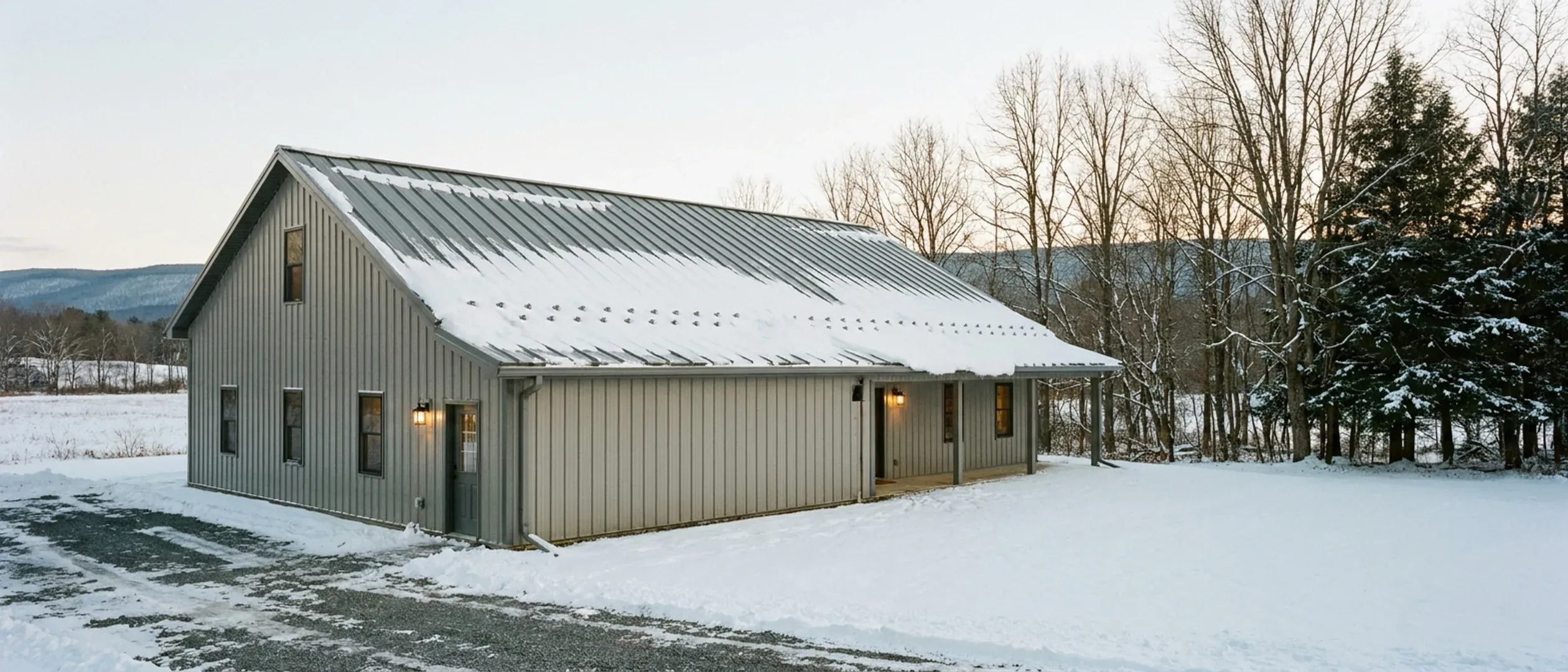
Barndominium Pros and Cons in Pennsylvania: Snow, Radon, Old Mines, Flooding and Appraisal
Most pros-and-cons lists for barndominiums are written for everywhere at once, which makes them true nowhere in particular. This one is written for Pennsylvania. Some of the advantages are structural and hold anywhere: a clear-span shell, and a shop and a house under one roof. Several of the disadvantages are Pennsylvania-shaped: lake-effect snow in the northwest and nor'easters in the east, a radon problem the Department of Environmental Protection calls one of the most serious in the country, abandoned coal and clay mines under a large share of the Commonwealth, flood damage that no standard homeowners policy covers, and rural land where the well is entirely the owner's business. Every claim below names its source. Where the honest answer is that it depends, the page says what it depends on.
Figures on this page are cited third-party or government data, not a quote from Pennsylvania Barndominium Builders.
Bottom Line Up Front
- The real structural advantage is the clear-span shell: no interior bearing walls, a floor plan you can change later, and a shop and a house on one foundation under one roof.
- The Pennsylvania-specific weaknesses are mostly about the ground and the weather, not the building type: snow loads your municipality sets, radon, old mine workings, flooding, and a private well nobody else inspects.
- Appraisal and resale are the soft spot. Rural land has fewer comparable sales, a large shop may not add value in proportion to its cost, and the lender's appraiser has to explain how the house was valued.
Three different buildings, one word
Before any advantage or disadvantage means anything, be clear which of these you are actually considering. The differences are structural.
Pole barn (post-frame) construction
Wood posts set in the ground or on piers, with girts and purlins carrying metal wall and roof panels. Economical for wide clear spans, and a long-standing way of building barns in Pennsylvania. The treatment of posts in ground contact, or a pier-and-bracket foundation that keeps them out of the soil, is a real specification choice.
Steel frame
Engineered steel columns and rafters on a concrete foundation, with the frame and its engineering usually supplied by the kit manufacturer. Ask the manufacturer what snow and wind figures the frame was designed for, and get them in writing, because those figures come from your municipality's building code official, not from the kit.
Conventional framing with metal cladding
A stick-framed house finished with metal siding and roofing. It looks like a barndominium but is built and inspected like any other house, and it gives up most of the clear-span advantage.
Where a barndominium genuinely wins
These advantages come from the structure itself, so they hold wherever the land is.
Clear span and a floor plan you can change
With no interior bearing walls, rooms are partitions. Moving a wall later is a remodel, not a structural project.
Shop and house under one roof
For people who need a shop, equipment bay or oversized garage anyway, one building and one foundation can replace two. That is the case where a barndominium's economics are strongest.
A roof that sheds snow and rain
Metal roofing sheds water quickly and, on an adequate pitch, sheds snow too. Where the snow slides to matters: keep doors, walkways and parking out of the discharge zone below the eaves.
Tall walls and big doors
Eave heights and door openings that would be expensive in a framed house are routine in a steel or pole barn building, which suits RVs, boats, trailers and farm equipment.
Where it is weaker, and what to do about it
None of these is a reason not to build. Each is a reason to decide something early.
Condensation behind the metal
Warm, moist indoor air meeting a cold steel panel condenses, and a Pennsylvania winter supplies plenty of cold panels. Insulation, vapour control, air sealing and ventilation have to be designed together, not added once the shell is up.
Appraisal and comparable sales
Fannie Mae's Selling Guide acknowledges that where there is a shortage of truly comparable sales, because of the nature of the improvements or few sales nearby, the appraiser may have to use properties that are not truly comparable and explain why. For rural properties it allows comparables a considerable distance away. A barndominium on acreage is often exactly this case, which can make the appraisal the limiting factor on a loan.
A big shop is not always big value
Fannie Mae treats outbuildings by scale: small barns of relatively insignificant value are acceptable if typical for the area, while significant outbuildings such as large barns or storage areas may indicate that the property is agricultural in nature, and the lender must decide whether it is residential. A large attached shop is not an outbuilding, but the same logic shows up in how lenders and appraisers look at a building that is half shop.
Heating a large volume
Tall walls and open spans are a lot of air to heat through a Pennsylvania winter. Zoning the heat so that the living quarters and the shop are controlled separately is usually worth more than an extra inch of insulation.
Pennsylvania rules that apply to every barndominium
These are the statewide facts behind several points on this page. The legal guide sets them out in full.
It is a house under the Uniform Construction Code
The Uniform Construction Code applies statewide, and since 1 January 2026 its residential code has been the 2021 International Residential Code with Pennsylvania's own amendments. A barndominium is built and inspected as a dwelling.
The agricultural exclusion does not reach the house
Agricultural buildings are excluded from the Uniform Construction Code, but the statutory definition of an agricultural building excludes habitable space. The living quarters of a barndominium are never an agricultural building, whatever the land is used for.
Your municipality, not the county, is where you start
Residential permits run through the municipality: a city, borough or township, or the third-party agency it works with. The legal guide explains how that works, including where a municipality has opted out of administering the code.
Reading this because you are weighing a build? The next step is a plan drawn for your program.
What's different about Pennsylvania
Snow: heavy in the northwest, storm-driven in the east
NOAA's State Climate Summary for Pennsylvania says lake-effect snow is a hazard for the northwestern part of the state, which can receive more than 100 inches of snow a year, and that the area east of the Appalachian Mountains is at risk from nor'easters. It notes that the Blizzard of 1996 dropped more than 30 inches of snow in several parts of the state. A wide, low-slope barndominium roof is exactly where snow load matters, and there is no single Pennsylvania figure to design to: under the Uniform Construction Code, the building code official for your municipality determines the climatic and geographic design criteria, including the ground snow load. Ask for that figure before the kit is ordered and give it to the manufacturer in writing.
Radon: test a barndominium like any other house
The Pennsylvania Department of Environmental Protection says Pennsylvania has one of the most serious radon problems in the United States and that approximately 40 percent of homes tested have radon levels above the EPA's action guideline of 4 picocuries per litre. A slab-on-grade barndominium does not escape the question: DEP notes that radon levels can also be high above ground, even in homes without basements. Plan to test once the house is closed in and occupied, and leave room in the slab and the roof line for a mitigation pipe if the result comes back high.
Old mines and sinkholes: a separate policy
The Pennsylvania Insurance Department's homeowners guide says damage from sinkholes and earth movement is generally excluded from a homeowners policy, and that communities above old mines can buy mine subsidence coverage through the State. DEP's Mine Subsidence Insurance programme exists because homeowners insurance usually does not include it; its brochure says there are coal deposits and abandoned mines in 43 of Pennsylvania's 67 counties. DEP's programme page quotes $41.25 a year for $150,000 of residential coverage and says coverage is available for complete and under-construction buildings. Check the land before you buy it, not after the slab is poured.
Flooding: never in the homeowners policy
The Pennsylvania Insurance Department says an important exclusion in all homeowners policies is loss due to flood, and that flood insurance can be bought for any insurable property, even outside a floodplain. Its flood insurance page says a policy from the National Flood Insurance Program usually carries a 30-day waiting period, while private flood policies typically have shorter ones. NOAA's climate summary records a large increase in extreme precipitation events in Pennsylvania and notes that heavy rain combined with spring snowmelt causes particularly damaging floods. Many barndominiums are built on rural land near streams, so get the flood quote while you are still choosing the site.
The insurance questions a metal building raises
In March 2026 the Pennsylvania Insurance Department urged homeowners to check whether they are insured for replacement cost or actual cash value, and the amount of their deductibles, including peril-specific deductibles for wind and hail. Its homeowners guide recommends carrying 100 percent replacement coverage and explains that most companies require at least 80 percent, with a partial-loss penalty below that line. For an unusual building type the practical step is to have an agent quote the finished barndominium, with its metal roof and any shop space, before construction starts.
Rural water is the owner's job
Penn State Extension says more than three million rural Pennsylvania residents use a well, spring or cistern as their primary water source, that unlike public water supplies these private supplies are not regulated, and that all testing, maintenance and treatment is the property owner's responsibility. It adds that research has shown more than half of these private systems fail at least one drinking water standard. A new well for a barndominium should be tested when it is first drilled, and the result belongs in the budget conversation before the house is designed around it.
Pros and cons, honestly
Pros
- Clear spans and no interior bearing walls: the floor plan is not fixed by structure and can be changed later.
- A shop, equipment bay or oversized garage and a house on one foundation under one roof.
- Tall walls and wide doors are routine rather than expensive.
- A metal roof sheds rain and, on an adequate pitch, snow.
- A frame built from engineered components that a kit manufacturer designs to the snow and wind figures your municipality sets.
Cons
- Wide, low roofs must be designed for the ground snow load your municipality's building code official sets, which is high in parts of the state.
- Condensation and heating demand in winter require careful insulation, vapour control and heat zoning.
- Radon, mine subsidence and flood are separate questions from the building, and the last two need insurance a standard homeowners policy does not include.
- A private well is entirely the owner's responsibility to test, maintain and treat.
- Fewer comparable sales for appraisal, particularly on rural acreage.
- A large shop may not add value in proportion to its cost.
Can a barndominium handle Pennsylvania snow?
Do barndominiums have radon problems in Pennsylvania?
Does homeowners insurance cover a barndominium for flood or mine subsidence?
Is a metal roof good or bad for insurance?
Are barndominiums hard to appraise?
Is a barndominium on farmland an agricultural building?
Who checks the well on a rural barndominium site?
Do I need a permit to build a barndominium in Pennsylvania?
Questions answered? Tell us what you want to build and we will put real numbers against it.
Sources
- NOAA State Climate Summaries 2022 — Pennsylvania (NOAA Technical Report NESDIS 150-PA)
- Pennsylvania Department of Environmental Protection — Radon in the Home
- Pennsylvania Insurance Department — Your Guide to Homeowners Insurance
- Pennsylvania Insurance Department — Flood Insurance
- Pennsylvania Insurance Department — Review homeowners insurance policies ahead of spring storms (9 March 2026)
- Pennsylvania Department of Environmental Protection — Mine Subsidence Insurance
- Pennsylvania Department of Environmental Protection — Mine Subsidence Insurance customer brochure
- Penn State Extension — Private Wells and Water Systems Management
- Pennsylvania Department of Labor and Industry — Uniform Construction Code
- 34 Pa. Code Chapter 403 — Uniform Construction Code administration
- Fannie Mae Selling Guide — B4-1.3-08, Comparable Sales
- Fannie Mae Selling Guide — B4-1.3-05, Improvements Section of the Appraisal Report
Keep reading
The pages that answer the next question this one raises.
Are barndominiums worth it?
The decision page: land, appraisal, insurance and the shop-plus-house case in Pennsylvania.
Read itAre barndominiums legal in Pennsylvania?
The Uniform Construction Code, zoning, sewage permits and earth disturbance behind several points on this page.
Read itPole barn homes
The post-frame construction method and what a building code official may ask for.
Read itSteel construction
Steel-frame barndominiums and the manufacturer engineering that comes with them.
Read itBarndominium financing
How appraisal and comparable sales affect the loan.
Read itStart the survey
Tell us about your land and what you need the building to do.
Read itWant a real number instead of a range?
Start the survey and tell us about your land and what you want to build. Include the municipality and parcel ID if you have them, because in Pennsylvania the township or borough, the slope, and the sewage and well answers change the budget more than the building does. The survey costs nothing.