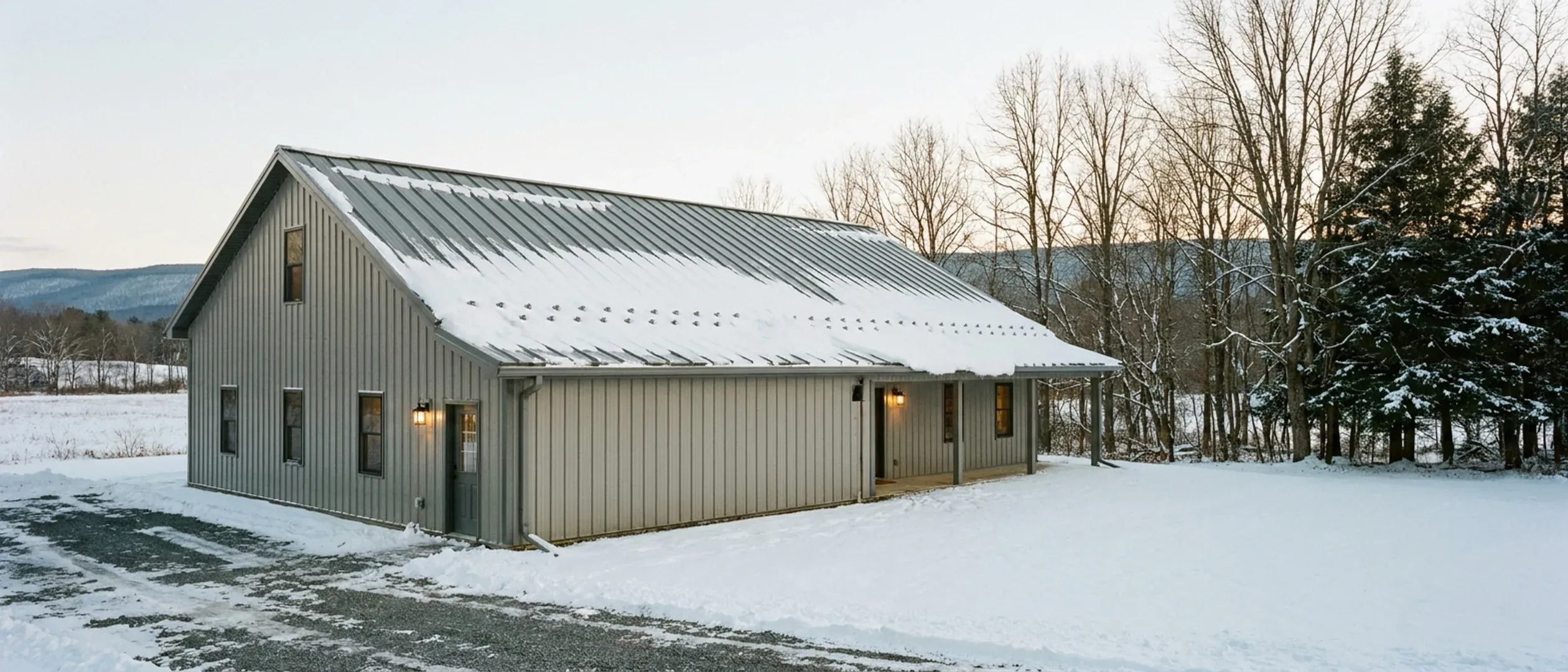
Are Barndominiums Legal in Pennsylvania? The Uniform Construction Code, Zoning, Sewage and Land Rules
Pennsylvania has no law aimed at barndominiums, for or against. What it has is a statewide building code that applies to every dwelling, about 2,560 municipalities that decide zoning and most enforcement, a sewage permit system run by local agencies, and statewide rules on earth disturbance, stormwater and floodplains that apply to any building site. A steel or pole barn home goes through the same process as any other new house. This page sets out each layer, who is responsible for it, and what to ask before you apply. It describes the law as written in the statutes and regulations cited at the foot of the page. It is not legal advice, and your municipality has the final word on its own ordinances.
Figures on this page are cited third-party or government data, not a quote from Pennsylvania Barndominium Builders.
Bottom Line Up Front
- Yes, a barndominium can be built legally in Pennsylvania as a house. The Uniform Construction Code applies statewide, and since 1 January 2026 its residential code has been the 2021 International Residential Code with Pennsylvania amendments.
- Where it may go is decided locally. Zoning and subdivision rules are set by each township, borough or city, and the county's ordinance applies only where the municipality has none. The agricultural-building exclusion never covers living space.
- Before the building permit, expect an on-lot sewage permit from the local agency's Sewage Enforcement Officer where there is no public sewer, erosion and sediment controls for the site work, and a PennDOT permit for a driveway onto a state road.
What the State sets, and what it leaves to your municipality
The code is statewide, but several decisions that shape a barndominium design are made locally.
Design figures come from the building code official
Under 34 Pa. Code § 403.103 and the matching rule for enforcing municipalities, the building code official determines the climatic and geographic design criteria in the residential code's design table, including ground snow load, wind speed and frost depth. There is no Pennsylvania-wide value for any of them. Ask for them before a kit is ordered.
The permit review clock
Under 34 Pa. Code § 403.63, a building code official must grant or deny a residential permit application within 15 business days of filing, or 5 business days where a design professional certifies that the drawings meet the code, or the application is deemed approved. The municipality will list the other permits required before the building permit is issued.
Detached shops and garages depend on size and ordinance
34 Pa. Code § 403.1 excludes detached private garages, carports, sheds and greenhouses under 1,000 square feet that are accessory to a detached one-family dwelling, except as an ordinance may require. A barndominium's attached shop is part of the dwelling. A separate building is a question for the municipality.
A driveway onto a state road
Under 34 Pa. Code § 403.63, a building permit for a property that needs access to a PennDOT highway must carry notice that a highway occupancy permit is required before the driveway connects to it.
Land rules that come with the site
These apply because of where the land is and how it is taxed, not because the building is a barndominium.
Clean and Green roll-back taxes
Land enrolled in Clean and Green, Pennsylvania's preferential assessment program under Act 319 of 1974, is taxed on its use value. If the use changes to one the Act does not allow, the land removed and the entire tract become subject to roll-back taxes, meaning the difference in tax for the current year and up to six previous years, plus 6 percent annual interest. A split-off for a house lot has limited relief: under conditions that include a two-acre annual limit and occupancy by the person the land is conveyed to, roll-back is due only on the split-off portion. The county assessment office administers the program, so ask it before you buy or subdivide.
Stormwater after development
Act 167 requires anyone altering or developing land in a way that may affect stormwater runoff to take the measures the applicable watershed plan requires, including assuring that the maximum rate of runoff is no greater after development than before. The municipality's stormwater ordinance sets how that is shown for your lot.
Flood hazard areas
Where a lot is in a mapped flood hazard area, the permit application must show the flood zone, the lowest floor elevation and the design flood elevation from the municipality's Flood Insurance Rate Map, and the municipality's floodplain ordinance decides what can be built there.
Who builds it: licences, registration and titles
Pennsylvania regulates a few trades and titles, and leaves the rest to municipalities.
No state general contractor licence
The Department of Labor and Industry says the Commonwealth currently has no licensure or certification requirements for most construction contractors. It says some municipalities have their own licensing or certification requirements, typically for electricians and plumbers, and that this can only be found out from the municipality where the work will occur.
Home improvement registration does not cover a new home
The Home Improvement Consumer Protection Act, Act 132 of 2008, requires home improvement contractors to register with the Attorney General and to show the registration number in all advertisements. Its definition of home improvement excludes the construction of a new home. According to the same definition, it does cover work over $500 at an existing private residence, including garages, driveways and roofs, so a shop or garage added beside a house you already live in is a different legal category from a new barndominium.
No architect required for most houses
The Architects Licensure Law does not prohibit anyone from preparing drawings for a detached one- or two-family dwelling of not more than three stories, or its accessory structures. The building code official may still require specific drawings to be sealed, for example a steel frame's engineering, which comes from the manufacturer.
The titles themselves are protected
The Architects Licensure Law and the Engineer, Land Surveyor and Geologist Registration Law make it an offence to use those titles, or to imply them in advertising, without the licence. Ask for a licence number from anyone who calls themselves an architect, engineer or surveyor.
What to ask before you apply
Five questions settle most of the legal path for a particular piece of land.
Does the municipality administer the code?
If it does, it issues the permit through its own staff or its appointed agency. If it has opted out, you hire a certified third-party agency for plan review and inspections.
What is the zoning district, and does it allow a dwelling?
Ask the municipality for the district, the setbacks, any minimum lot size and whether a house with a large shop fits its definitions. If the municipality has no zoning, ask whether a county ordinance applies.
Who is the Sewage Enforcement Officer?
Unless public sewer is available, the local agency's Sewage Enforcement Officer tests the soil and issues the on-lot sewage permit, usually before the building permit.
How much ground will the site work disturb?
At 5,000 square feet a written erosion and sediment control plan is required, and at 1 acre an NPDES construction stormwater permit administered with the county conservation district.
Is the land in Clean and Green, or on a state road?
The county assessment office can say whether the land is enrolled and what a split-off would trigger. PennDOT issues the highway occupancy permit for a driveway onto a state road.
Reading this because you are weighing a build? The next step is a plan drawn for your program.
What's different about Pennsylvania
One statewide building code
The Pennsylvania Construction Code Act, Act 45 of 1999, applies to the construction, alteration, repair and occupancy of all buildings in the Commonwealth. Its Uniform Construction Code adopts the International Residential Code for houses, but selectively: the 2021 edition, with Pennsylvania's own amendments, took effect on 1 January 2026 under 34 Pa. Code § 403.21, replacing the 2018 edition that had applied since 14 February 2022. Pennsylvania has not adopted the 2024 edition. A project whose design or construction contract was signed before an effective date follows the code in force when the contract was signed.
Enforcement is municipal, and a few municipalities opted out
The Department of Labor and Industry says over 90 percent of Pennsylvania's 2,562 municipalities have elected to administer and enforce the Uniform Construction Code locally, using their own employees or certified third-party agencies they retain. Where a municipality has opted out, Act 45 makes the permit applicant for a one- or two-family dwelling responsible for hiring a certified code official or third-party agency to do the plan review and five inspections: foundation; plumbing, mechanical and electrical; frame and masonry; wallboard; and final. The municipality still tells the applicant that this is required.
The agricultural exclusion does not reach a house
Act 45 excludes agricultural buildings from the code, but its definition of an agricultural building says the term shall not include habitable space. The living quarters of a barndominium are therefore never an agricultural building, whatever the land is used for. A barndominium someone lives in is built, permitted and inspected as a dwelling.
Zoning is set by the municipality
Under the Municipalities Planning Code, the governing body of each municipality may enact zoning and subdivision and land development ordinances. A county's zoning ordinance applies only in municipalities that have none of their own, and a municipal ordinance repeals it within that municipality. Because the power is optional, some municipalities have no zoning. The Code's definition of a municipality does not include Philadelphia or Pittsburgh, which zone under their own codes. Whether a barndominium is allowed in an agricultural or rural district is decided by each municipality's ordinance, not by the State.
Sewage: a permit from the local agency, after soil testing
Under the Pennsylvania Sewage Facilities Act, Act 537, an on-lot sewage system is permitted by the local agency's Sewage Enforcement Officer. The local agency is the municipality, a group of municipalities acting jointly, or a county health department; in Allegheny, Bucks, Chester, Erie and Montgomery counties it is the county health department, and in Philadelphia the City. 25 Pa. Code § 72.22 says no one may construct or occupy a building to be served by an on-lot system without first obtaining that permit, apart from limited exceptions. Soil tests come before the permit, and under § 73.14 a limiting zone within 20 inches of the mineral soil surface means percolation tests may not be conducted and a permit will be denied, except for bonded systems.
Earth disturbance, stormwater and floodplains
25 Pa. Code Chapter 102 requires erosion and sediment control practices on every earth disturbance, a written erosion and sediment control plan once disturbance reaches 5,000 square feet, and an NPDES permit for stormwater discharges from construction activity at 1 acre or more, including where the site is part of a larger common plan of development of that size. County conservation districts administer the program under delegation from the Department of Environmental Protection. Under the Storm Water Management Act, Act 167, municipalities adopt ordinances that implement their county's watershed plans, and under the Flood Plain Management Act, Act 166, municipalities with mapped flood areas must take part in the National Flood Insurance Program. The building permit application for a site in a flood hazard area uses the municipality's Flood Insurance Rate Map.
Are barndominiums legal in Pennsylvania?
Do I need a building permit for a barndominium in Pennsylvania?
Which building code applies in Pennsylvania?
Is a barndominium on a farm exempt as an agricultural building?
Does the county issue building permits in Pennsylvania?
Do I need a septic permit for a barndominium?
When does site work need an erosion and sediment control plan?
Will building on Clean and Green land cost me roll-back taxes?
Do I need an architect to design a barndominium in Pennsylvania?
Does my builder need a state licence?
Questions answered? Tell us what you want to build and we will put real numbers against it.
Sources
- Pennsylvania Construction Code Act, Act 45 of 1999
- 34 Pa. Code Chapter 403 — Uniform Construction Code administration
- Pennsylvania Bulletin, 55 Pa.B. 7701 — Uniform Construction Code update effective 1 January 2026
- Pennsylvania Department of Labor and Industry — Uniform Construction Code
- Pennsylvania Department of Labor and Industry — Contractor Licensing
- Pennsylvania Municipalities Planning Code, Act 247 of 1968
- Pennsylvania Sewage Facilities Act, Act 537 of 1965
- 25 Pa. Code Chapter 72 — Administration of Sewage Facilities Permitting Program
- 25 Pa. Code Chapter 73 — Standards for Onlot Sewage Treatment Facilities
- Pennsylvania Department of Environmental Protection — Municipal On Lot Sewage Service Areas
- 25 Pa. Code Chapter 102 — Erosion and Sediment Control
- Storm Water Management Act, Act 167 of 1978
- Flood Plain Management Act, Act 166 of 1978
- Pennsylvania Farmland and Forest Land Assessment Act (Clean and Green), Act 319 of 1974
- Home Improvement Consumer Protection Act, Act 132 of 2008
- Architects Licensure Law, Act 281 of 1982
- Engineer, Land Surveyor and Geologist Registration Law, Act 367 of 1945
Keep reading
The pages that answer the next question this one raises.
How long does it take to build a barndominium?
How sewage testing, the permit review clock and the seasons fit into the schedule.
Read itPermitting
Putting the application together for your municipality.
Read itSite preparation
Clearing, grading and the building pad, within the erosion and sediment rules.
Read itBarndominium pros and cons
Snow, radon, old mines, flooding and appraisal.
Read itAre barndominiums worth it?
Land, appraisal, insurance and resale.
Read itStart the survey
Tell us where the land is and we will look at what applies.
Read itWant a real number instead of a range?
Start the survey and tell us about your land and what you want to build. Include the municipality and parcel ID if you have them, because in Pennsylvania the township or borough, the slope, and the sewage and well answers change the budget more than the building does. The survey costs nothing.